
Countdown to Convergence®
Marcy Petrini
July, 2016
Next month at this time, I will be at Convergence® in Milwaukee, Wisconsin. I am not quite ready yet, but I will be by the time we are set to leave.
Between seminars, studio classes, and a super-seminar, I have five to teach and, to date, over 140 participants. I am truly excited.
That translates to over 12,000 pages to print! Each participant receives at least a monograph and they range from some 50 pages to over 100. The printing has begun – but it’s my husband Terry who is printing, punching and binding. Being organized is the key to getting it done.
Now that I am close to the finish line, here are some highlights of the various presentations.
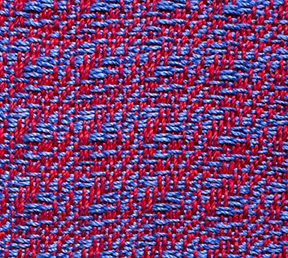
I am finished with the monograph for Four to More; that will be on Wednesday morning. I have woven some samplers for it and I have written about them in previous blogs. But here is a fancy basket weave on eight shafts that was an early piece on eight shaft I wove.

For the Interaction of Structure and Function on Thursday: twills, silk and shawls seem perfect for each other. Then again, how about this silk shawl with huck lace stripes?

Weaving Errors will be on Friday morning. Those topics, too, have been discussed in previous blogs. But here is a picture from the series on how to fix a broken warp thread. The replacement warp end is shown in gold to make it obvious. Pictorial steps by steps should make it easier for participants to fix them in the future.

I have woven several samplers in color and weave for that seminar on Friday afternoon, each with several samples and I have written about some of them in previous blogs. This is my one of favorites, alternating red and black on a birds’ eye threading and treadling. I must have liked the motifs so much that I just discovered that the eight-shaft deflected double weave I am currently working on has similar motifs of crosses and boxes!

The studio on Saturday will be on Reinventing-Twills. I love twills, and I have written six previous blogs on them. Here is the simplest of twills, front and back, on thee shafts, where it all starts.

I will take a break from writing this blog as I get ready for Convergence®. I will resume after the conference, but on a monthly basis. I hope to see you in Milwaukee!
Please email comments and questions to
Four and Eight Shaft Twills II
Marcy Petrini
June 13, 2016
Last week (6-June-16 Blog) I compared undulating twills on 4 and 8-shafts, which I am including in my Convergence™ monograph; this week we’ll compare advancing twills.
Here is the drawdown for an advancing straight twill on four shafts. (Right-click on these drafts to get a larger version in a new window.)

The fabric is woven tromp as writ, so both of threading and the treadling are a bit complex. The repeat starts with a complete straight twill, but it doesn’t have to.
If we use a pointed twill as the starting point for the advancing, the treadling can be a straight draw as shown in the next drawdown.

The fabric for this twill doesn’t show the pattern very well, but the motif contributes to the complex way in which the light is reflected because the floats change direction repeatedly.

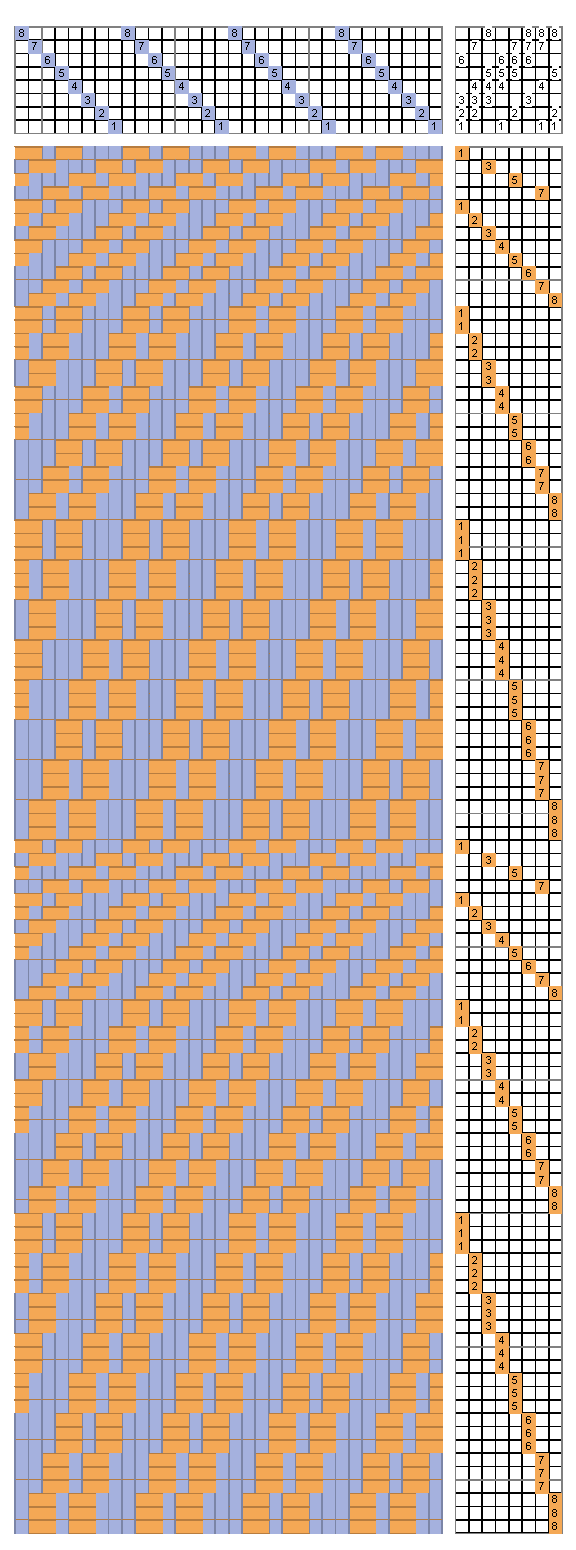
The next advancing twill is on eight shafts. From the drawdown, note that the threading is that of a straight twill and the advancing occurs in the treadling which is based on a pointed twill. Of course the advancing could be done on the threading as well. The eight shafts make it possible for the zig zag to be doubled with the floats interrupted by the warp.

The resulting fabric below shows the same characteristic mentioned for the four shaft twill, the light reflects as the floats change direction.
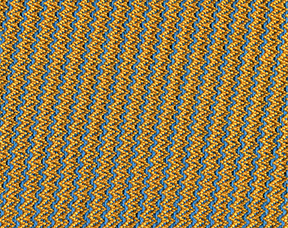
Whether on four or eight shafts, these twills have a level of complexity that results in interesting fabrics.
Please email comments and questions to
Four and Eight Shaft Twills
Marcy Petrini
6/6/2016
I preach that it would take more than one life time to weave all of the 4-shaft twills, let alone all the other structures possible on four shafts. Still, eight shafts offer more options, there is no disputing it.
I am in the process of writing about 8-shaft twills for my Convergence™ monograph and two twills caught my attention: undulating twills and advancing twills.
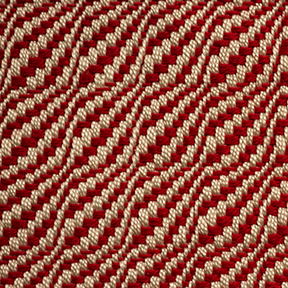
The blog of Dec 21, 2015 was on four shaft undulating twills. Below is another sample on four shafts. It was woven a bit differently than those previously described, as seen in the drawdown that follows. (Right-click on these drafts to get a larger version in a new window.)
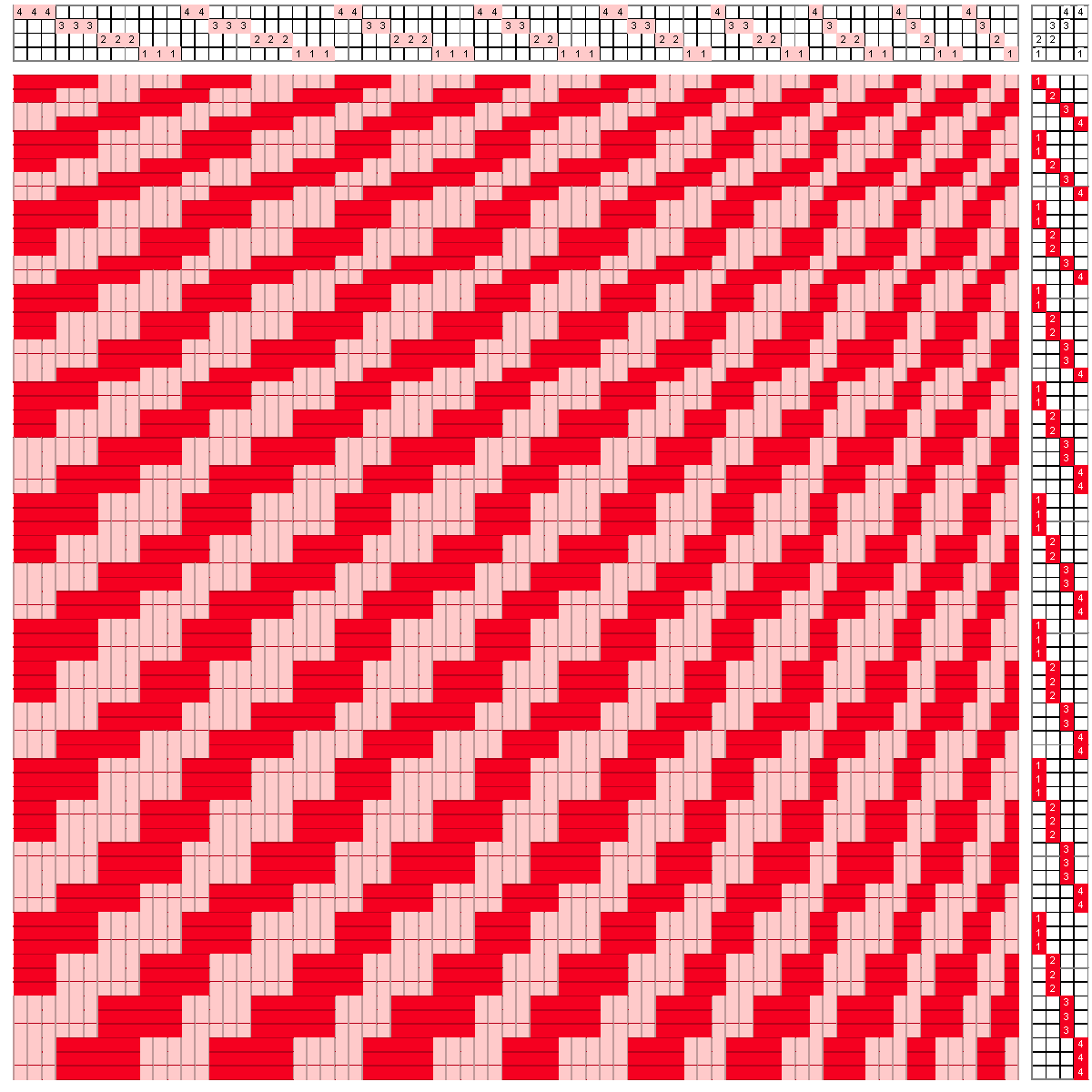
The draft above shows one repeat of the pattern so that the threading and treadling can be read. The following drawdown has two repeats, showing the undulation more completely.

The fabric that follows is an undulating twill on eight shafts. Unlike the one on four shaft, this one was threaded on a straight draw and all of the undulating occurs in the treadling. Of course it’s possible to thread an undulating twill on eight shafts, but that sometimes is the advantage of more shafts: the threading can be simple and the treadling does all the work.
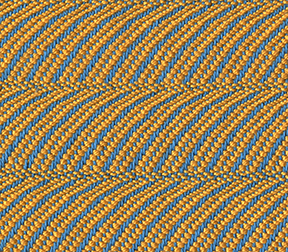
The drawdown below shows two repeats of the treadling for this eight-shaft twill; it looks complicated but it really isn’t because of its repetitive nature; the treadling on eight shafts is not any more complicated than the one on four shafts.
Regardless of the number of shafts, floats can be long with these twills, so careful planning is necessary.
Are more shafts worth it in this case? You be the judge, it’s a personal decision.
Next time, a similar comparison for advancing twills.
Please email comments and questions to
Shadow Weave II
Marcy Petrini
5/30/2016
In the blog of April 18, 2016, I talked about the unique characteristics of Shadow Weave: on one hand, it’s a Color and Weave, on the other hand, the motifs can maintain the look of the underlying weaving structure, usually a twill; this is generally not the case with the non-Shadow-Weave Color and Weave motifs, which tend to be optical illusions hiding the weaving structures that produce them.
I mentioned that I was weaving samples. Those are for the monograph on Color and Weave that I am writing for my Convergence™ seminar. So, here is a peak and another look at why Shadow Weave can be considered Color and Weave.
Below again is the drawdown from the April 18, 2016 blog: (Right-click on this draft to get a larger version in a new window.)
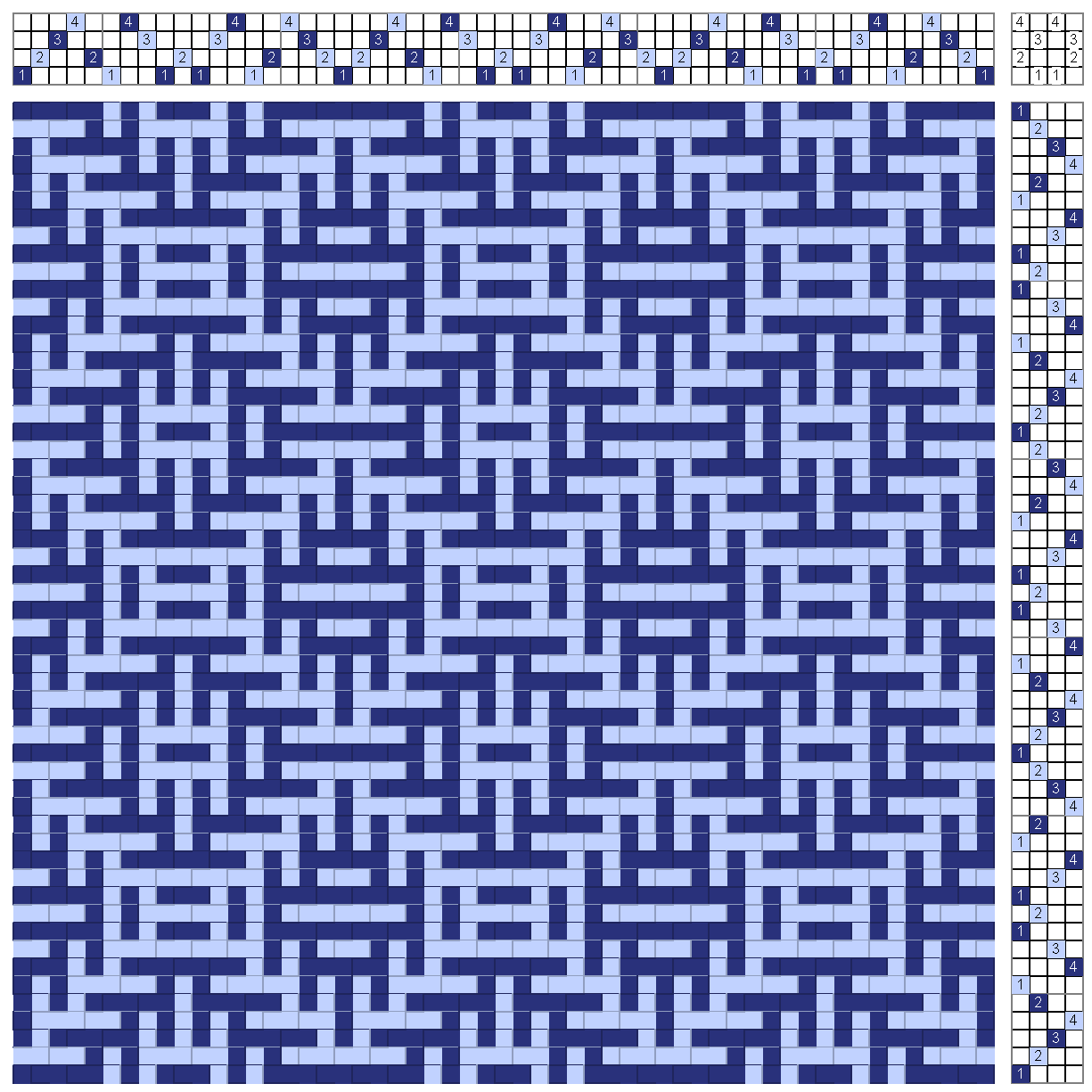
And here is the sample, wet finished after coming off the loom:

The staggered diamonds of the pointed twill are visible in the cloth, even more clearly than the drawdown. But zoning in close to the middle of one of the diamonds clearly reveals why this is a Color and Weave:
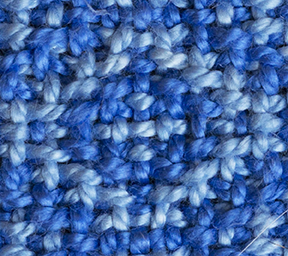
The solid lines that make up the motifs are not floats, as they are in a pointed twill, but are the result of the intersection of the same color warp and weft.
Powell’s book offers a life time of exploration for Shadow Weave. Maybe after Convergence I will be inspired to go back and try others……
Please email comments and questions to
Lifetime Achievement Award
Marcy Petrini
5/23/2016
I was very honored this past Thursday (5/19/16) to receive a Lifetime Achievement Award from the Craftsmen’s Guild of Mississippi (CGM) at a Guild Luncheon. I was introduced by Kathy Perito, my co-instructor for the fiber classes at the CGM, who is also an HGA Board member. I was asked to talk about my relationship with the Guild and what follows is a summary of what I said.
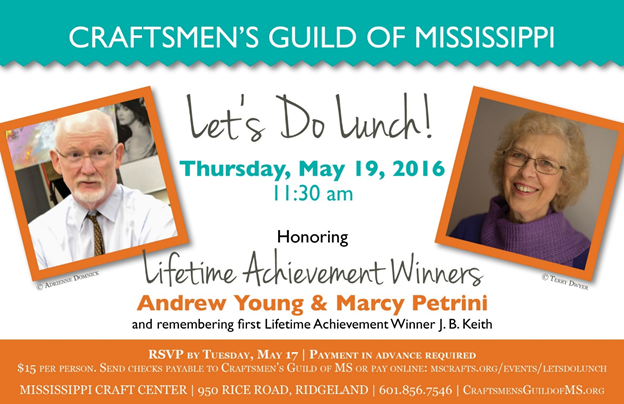
I thanked Kathy Perito, Ken McLemore, CGM President, the CGM Board of Directors, and the staff of CGM: Nancy Perkins, CGM Executive Director, Sheri Cox who has been involved with the weaving class for many years in one capacity or the other, and Tomika Cheatham who besides being a financial guru served as the registrar for the weaving classes for many years. I also thanked past Executive Directors for their support and I was happy that VA Patterson, Julia Daily and Kit Davis were present.
My fiber life started early in Italy where all of the women on Dad’s side of the family were fiber people. But it was my Dad who taught me that I could do whatever I set my mind to do (good thing I didn’t want to become a brain surgeon!), but whatever I did, to take it seriously, without taking myself too seriously; this led my weaving from a hobby to become a passion; he also taught me not to plan too closely because life has a way of making its own plan.

Based on that advice, I decided not to stay in Chicago for my graduate degree but instead to go to the University of Rochester. It seemed crazy at the time, but after some six years, I had met and married my husband Terry Dwyer who build me my loom, learning to weave at the university gallery and got my degree!
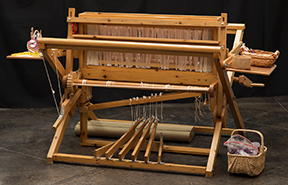
When we moved to Mississippi, it was Dan Overly, the Founder of the CGM and its first Executive Director, who convinced me to apply for Guild membership, even though I told him that I didn’t weave enough to sell my work; he pointed out that education is an important part of the Guild. Once accepted, to talked me into teach weaving, even though I objected that I had never taught weaving before.
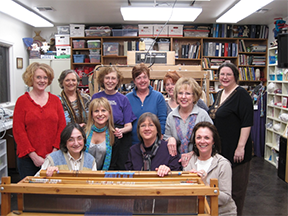
So started my teaching weaving career. The looms the Guild owned had gone through a flood, needed a lot of work, but luckily Terry was familiar with looms, so he was the one maintaining them. The Guild’s offices and classes were housed in the old President’s House at Millsaps College. The sales gallery, craft demonstrations and festivals were at the then Craft Center on the Natchez Trace, a log cabin owned by the National Park Service. With my weaving class producing new weavers and under Dan leadership, the Chimneyville Weavers Guild became a reality. It flourished and later became the Chimneyville Weavers and Spinners Guild; we will be celebrating our 35th anniversary this fall. Here we are a few years back celebrating my new studio.
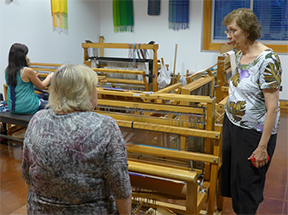
When it was time to demolish the President’s House, the Guild’s offices – and the looms – moved to the Craft Building on the Agricultural and Forestry Museum grounds. But we finally got a permanent home! When the new Craft Center was built, the Guild consolidated everything into this wonderful building. Looms had to be moved again – and hopefully for the last time! The studio is smaller, but it’s quality over quantity.
At some point my friend and former student Gio Chinchar asked me whether I didn’t get tired week in and week out to go teach the same class. And I said, no, it wasn’t really the same class; new students come, new challenges arise as we have a seemingly infinite number of combinations of fiber, yarns, colors and weaving structures. Each class is different and the teaching has progressed to writing, starting with the handouts I provided for the students. This led to my writing. In the late 90s I was asked to write a column called Right from the Start for Shuttle Spindle & Dyepot, the periodical of the Handweavers Guild of America. I became its regular columnist and I just wrote my 70th article. Now we also publish monographs on various weaving topics.
But I started thinking about the future; I couldn’t teach the class forever and I didn’t just want to walk away from a 35-year long project. At some point I would need to find someone to take over, but who? One happy day, this great lady entered into my life. Here is Kathy (Perito) with me at the Guild’s 40th Anniversary party. Kathy started as a student and it became obvious that she “got it” from day one. She became my assistant, and soon after my co-instructor. She quickly learned weaving structures, understands the looms, has great creativity and a can-do attitude that makes the class really fun. And it’s a great luxury for me – she does all the hard work, I get to think about what students need to know so I can write about it!

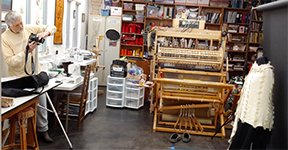
None of this would have been possible without this wonderful man, my husband Terry (Dwyer). He built my first loom, in the front of the studio here, maintained those in the Guild for many years, and assembled the computerized loom, in the back of the studio in the picture, from many, many boxes; he is the webmaster for my website and posts my weekly blogs. And here he is making a mess of my studio to take pictures, but then, I need those pictures!
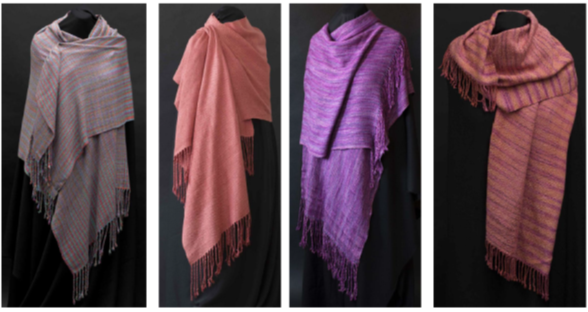
And here are some of the photos he took of my work. I don’t sell my pieces because every one of them is one of a kind that I need for my teaching and my writing; each one is an example of a weaving structure, technique, fiber, yarn, or color combination. I think of them as my reference library.
Again, I am greatly honored and very happy to have been a part of the Guild all these years.
Please email comments and questions to