
|
More Sapphire! |
Marcy Petrini
March, 2026
In February, I described how I arrived at finding the sapphire colors I needed to design a scarf for the Chimneyville Weavers and Spinners Guild 45th Anniversary celebration. I used Munsell 10 blue for the sapphire blue and Munsell 10 yellow for the sapphire yellow.
The scarf is off the loom and in the exhibit that the CWSG organized for our celebration. Here is a photo:
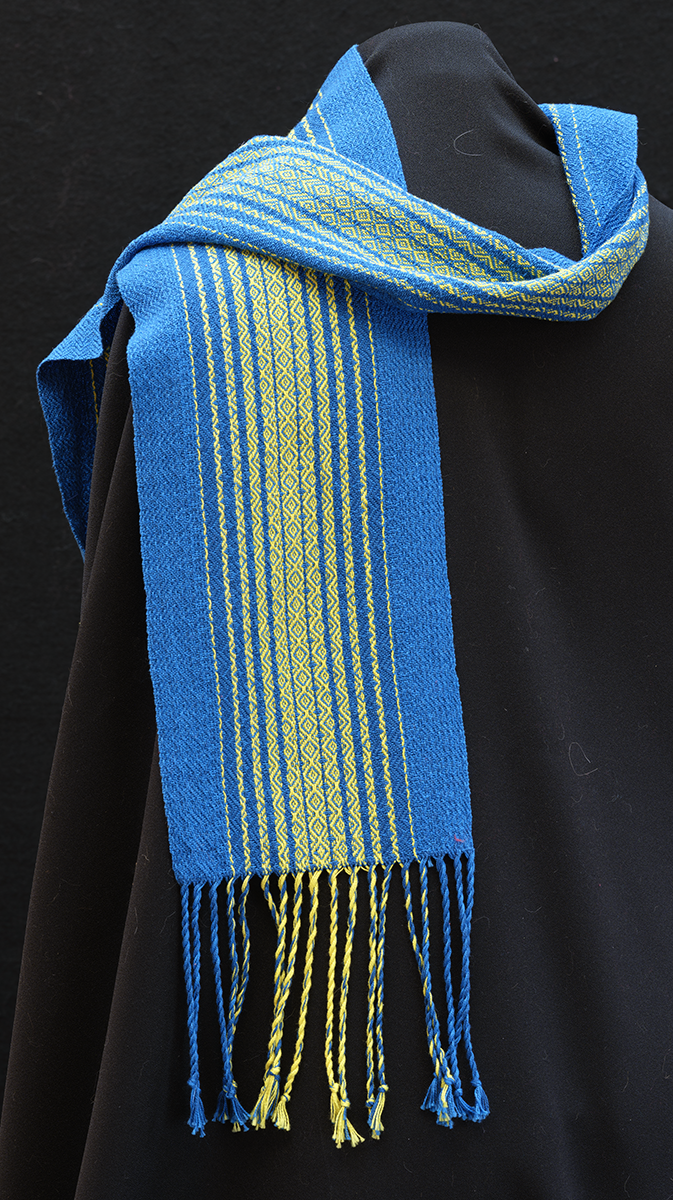
The two opponent colors – blue and yellow – with the twill lines make the scarf shimmer in the light as we can see from the photo.
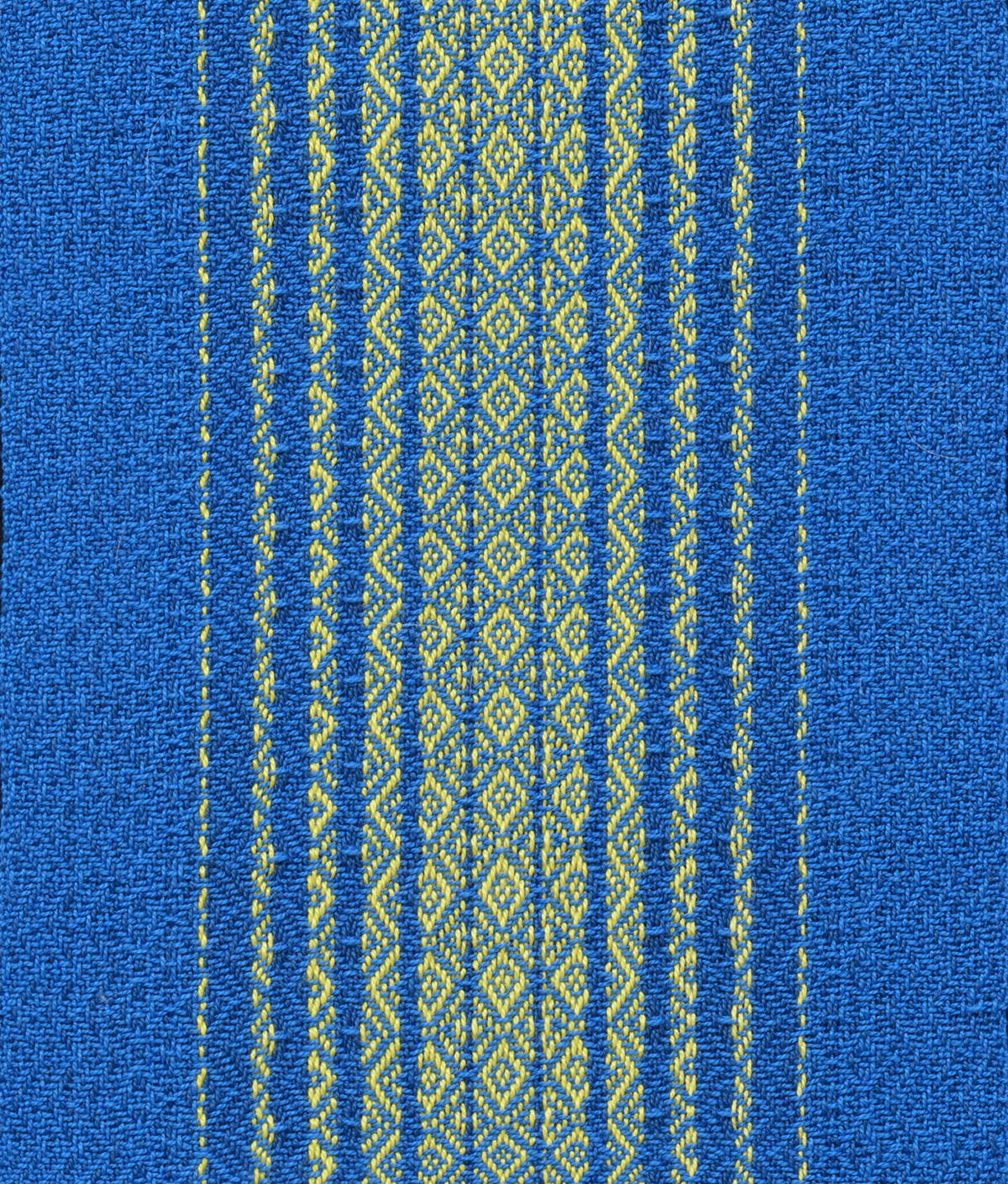
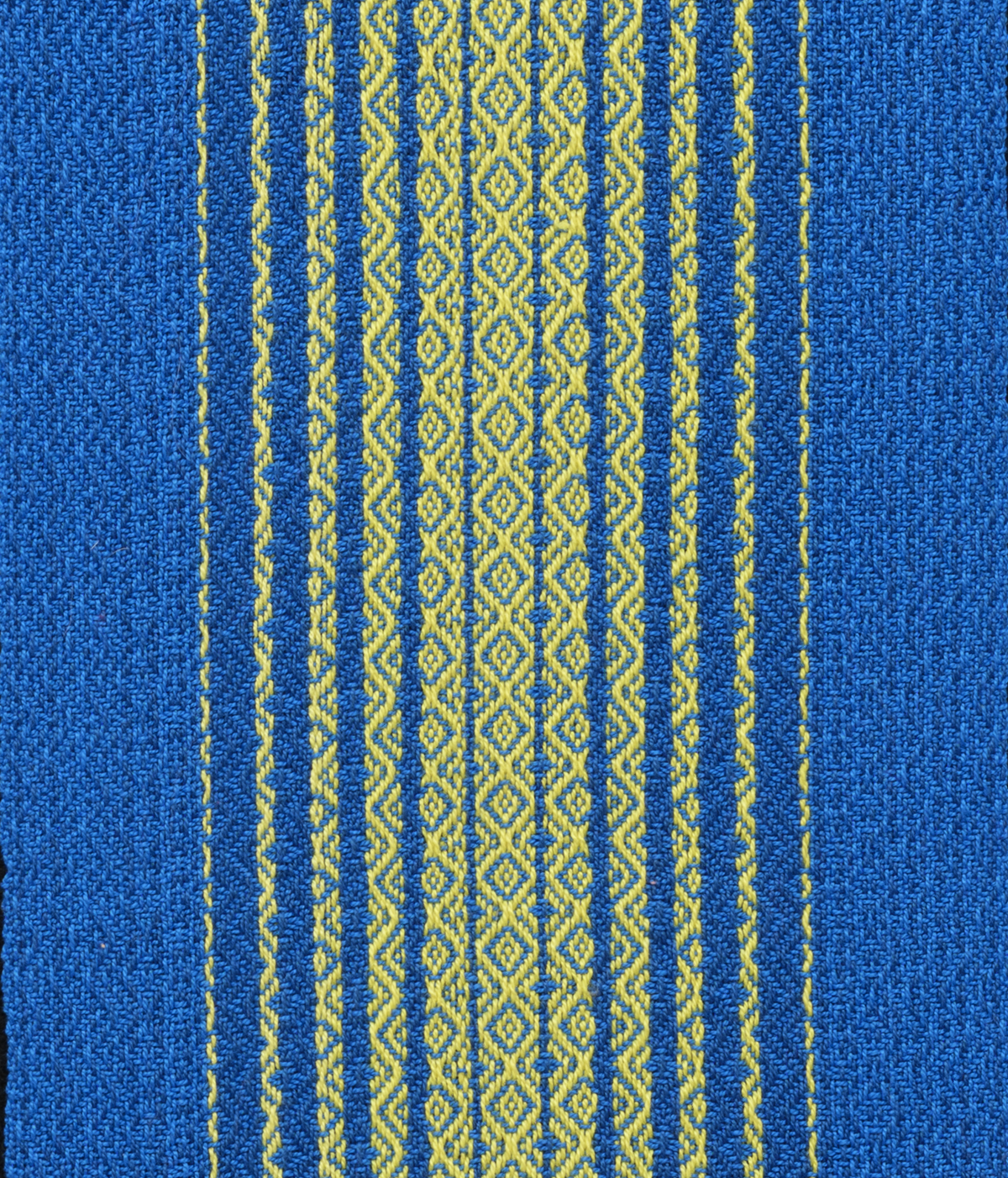
Below are close-ups of the front and back of the scarf.
 |
 |
When researching what is considered the standard sapphire blue, I came across other sapphires with descriptors to distinguish them from the standard. Once I was settled on what I wanted to weave, I became curious how these different sapphires may look.
I found six other hues (Munsell’s terminology for color) that carry the sapphire name: bright sapphire, deep sapphire, royal sapphire, cobalt sapphire, Pantone’s blue sapphire and one simply called sapphire by some, but dark cyan by others.
Just as in the standard sapphire blue, all these other sapphire hues have hex numbers which can be translated into the percentage of RBG out of 100% for each color. Two other parameters can also be calculated: the value and the saturation.
The value as used in the Munsell’s system – also known as lightness in computer graphics – represents how light or dark the color is, obtained by adding black or white; a value of 100% is pure white, 0% is pure black.
Saturation is similar in concept to Munsell’s chroma, how much of a given hue is present; this allows us to distinguish sky blue from navy blue.
It’s fun to see how these sapphire hues compare. Below are tables with the numerical information and squares of the hues for comparison (much of the information is from ColorHexa.com).
|
Color Name |
Standard Sapphire |
Bright Sapphire |
|
Hex Code |
0f52ba |
0067bc |
|
Red |
6% |
0% |
|
Green |
32% |
40% |
|
Blue |
73% |
74% |
|
Lightness (or Value) |
39% |
37% |
|
Saturation |
85% |
100% |
The standard sapphire blue is vibrant from the red / green interaction; the bright sapphire blue has no red, more green and a similar amount of blue. As a result, bright sapphire is more saturated, resulting in a deeper color.
|
Color Name |
Standard Sapphire |
Deep Sapphire |
|
Hex Code |
0f52ba |
082567 |
|
Red |
6% |
3% |
|
Green |
32% |
15% |
|
Blue |
73% |
40% |
|
Lightness (or Value) |
40% |
22% |
|
Saturation |
85% |
86% |
Again, the standard sapphire blue is vibrant from the red / green interaction; the deep sapphire blue has much less red, green and blue. With this smaller amount of illumination, the sample is much darker (the lightness/value is less).
|
Color Name |
Royal Sapphire |
Cobalt Sapphire |
|
Hex Code |
305cde |
0047ab |
|
Red |
19% |
0% |
|
Green |
36% |
28% |
|
Blue |
87% |
67% |
|
Lightness (or Value) |
53% |
34% |
|
Saturation |
73% |
100% |
The brightness of the royal sapphire is also from the red/ green interaction that we saw in the standard sapphire, with more red and a higher value. Compared to it, the cobalt sapphire is intense, with no red, relatively more blue and a higher saturation. The cobalt sapphire is darker since the red, green and blue numbers are all smaller than with the royal sapphire.
I found it interesting that the Pantone’s Blue Sapphire has a lot of green, leaning it toward teal; and following that lead, a color called dark cyan by ColorHexa.com is called “Blue Sapphire” by others. Given that the green sapphire gems are some of the rarest, those color names are understandable.
|
Color Name |
Pantone’s Blue Sapphire |
Blue Sapphire (Dark Cyan) |
|
Hex Code |
126180 |
006e75 |
|
Red |
7% |
0% |
|
Green |
38% |
43% |
|
Blue |
50% |
46% |
|
Lightness (or Value) |
29% |
23% |
|
Saturation |
75% |
100% |
The deep teal of the Pantone sapphire is from more red and less saturation than the blue sapphire / dark cyan. The dark cyan has nearly equal amounts of green and blue and full saturation resulting in cyan being a better descriptor of the hue.
By the way, if you print this blog, the sapphires may not look the same as on the screen because, while the RGB code is how the screen’s pixels present colors, printers use CMYK inks – hence some sort of conversion is needed.
What a wonderful experience! Who knew that starting with a simple question – how did we get from sapphire the gem to sapphire the color? – would lead to a path that taught me some color history, some color nomenclature and more about the interactions of colors.
Check out the ColorHexa.com website, it’s a great resource for thinking about color schemes for your yarns.
Happy Weaving in Color!
Marcy