
|
Sapphire! |
Marcy Petrini
February, 2026
At the September 2025 meeting of the Chimneyville Weavers and Spinners Guild Vice President Donna Peyton issued a challenge: to celebrate the guild’s 45th Anniversary, each one of us should use a Sapphire color to create a fiber project. The guild will have an exhibit during Sheep to Shawl and pieces are due at the February meeting.
Donna provided a one-page handout chock full of information: the various colors of the sapphire gems, not only various blues, but also pink, yellow, purple, and green. She also included the RGB hex number of Sapphire blue and how it looks.
I knew already that hex numbers define colors according to their composition (red, green and blue, RGB), but how did we go from a gem of various colors to one hex number? Now I had homework to do. Since I am interested in the science of color, this project has been a nice “rabbit hole” to go down, especially since I took my husband Terry Dwyer with me (very helpful with the chemistry and physics). It has resulted in many interesting conversations at the dinner table.
First, the gem. Sapphire is classified as a corundum, a colorless aluminum oxide (Al2O3, for you chemists) with an interesting chemistry. When tiny impurities of titanium and iron replace the aluminum, the corundum can change color. When titanium alone replaces some of the aluminum, the corundum is colorless. If iron alone replaces some of the aluminum, the sapphire can be yellow or green. It’s the combination of the two that gives us blue. Different chemical interactions between titanium and iron give us different blues, darker with more iron, more brilliant from the titanium.
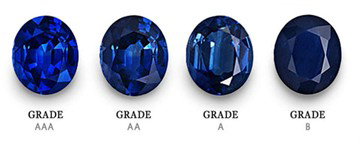 |
| Image from Sapphire Color Value Chart (which would really like me to buy a sapphire). |
Other impurities result in the other colors, but the chemical interactions are different since it is only one impurity that produces the color: chromium gives us ruby, a corundum of various reds; vanadium results in purples; black corundum, called emery and used as an abrasive, has a mixture of magnetite, hematite and spinel.
But how did we go from these gems to one generally accepted standard blue sapphire?
The naming and standardization of colors is an interesting subject. In 1929 Munsell derived a system that fiber artists still find useful today. He used a chromatography technique to measure color but also included the psychological portion of color detection. His purpose was not fiber but paper, and other uses, for example food science and soil.
In 1930, Maerz and Paul published A Dictionary of Color which was revised in 1950.

In it they categorized colors with names already in use at the time and matched them to the Munsell system when possible.
In 1956, Color, universal language and dictionary of names, by Kenneth Low Kelly, standardized colors as part of the National Bureau of Standards. The book shown here is the 1976 revision, available for purchase as a black and white reprint, but it has no color plates (!). However, it can be downloaded for free from the NBS with the original color plates.

Pantone arrived at its own system in 1963, which extends to many different materials, including shiny metallic colors. It is widely used in fashion and in the printing business.
With the arrival of computers, a way to determine the position of each color on a screen was needed; the RGB was standardized (sRGB). When the web arrived in the 1990s, programmers needed a better way to define colors across platforms. The hex system was introduced in 1996 with the first specification of the Cascading Style Sheet used by web programmers. It became the standard.
The hex 0F52BA (on a scale of 0 to 255) is the most widely accepted sapphire number.

I color-coded the hex number because each pair of digits represents a color in the system used for our computer screen, RGB. For the sapphire number, we have 15 Red, 83 Green and 186 blue, which I find easier to think in percentages: 6% of the red (of the total 100% possible red), 32% of the green and 73% blue.
From the hex number, we can find the equivalent color in other systems, for example the cyan, magenta, yellow and black, the colors of our printer cartridges. Pantone uses names which corresponds to hex numbers when possible (but not for the metallics, for example).
It was time to weave. I searched the internet for a yarn with the color sapphire with no luck. My friend Gio Chinchar had the same result.
Time to look at what available colors with known specifications can come close to sapphire.
Lunatic Fringe has yarns that follow the Munsell system. They also have cards for all their colors with information, including the hex number, the RGB number, the value and the Pantone number.
At this point I had looked at enough sapphire blue to think that Mansell Blue 10 could work. This is my favorite blue, and I have used it a lot.
The RGB percentages for the Munsell 10 blue are: 0% red, 31% green and 66% blue. It has a value of 70 (on a scale of 0 10 100), while Sapphire has a value of 60. All and all, not a bad match; 10 Blue has no red, but it has a higher value and thus a bit darker.
To contrast the 10 Blue, I wanted to use a yellow. Doing an after-image gave me a bright yellow. I thought the 10 Yellow would work, but I thought I should check it, especially since yellow sapphire has a hex number.
Here is the comparison:
|
Yellow |
100% Red | 84% Green | 0% Blue |
| 10 Yellow: | 99% Red | 89% Green | 0% Blue |
Good match!
Finally, it was time to design the project, a scarf. I thought it may be fun to call it:
Diamonds Sapphires are a girl’s best friend
This is the entire drawdown for the 8” scarf, no repeats. Lots of diamonds sapphires!

Scarf is still on the loom… stay tuned…..
Happy Weaving!
Marcy